Back to Blog
Improving Warehouse Object Detection by 30% with Tensorleap, NVIDIA Isaac Sim and NVIDIA Cosmos

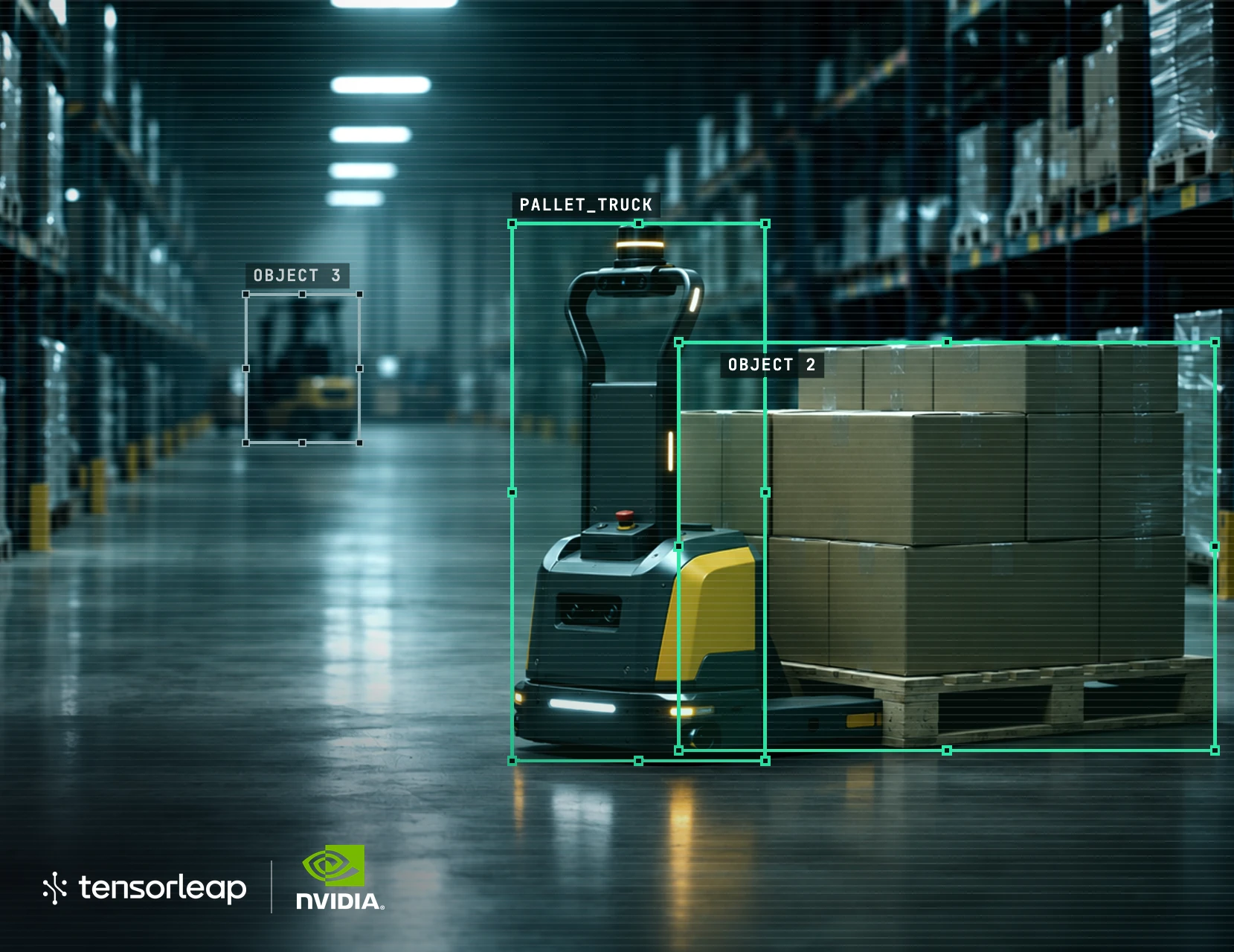
Generating more synthetic data isn't the bottleneck. Generating the right data is.
Physical AI perception models can look reliable in validation and still fail in deployment. A different camera height, field of view, level of clutter, or amount of motion blur can push important frames beyond what the model learned. Collecting and annotating real data covering this variation is slow and expensive. Synthetic data offers scale, but introduces another problem: its distribution may not match the real-world conditions the model needs to handle.
The tooling for generating synthetic data is now excellent. NVIDIA Isaac Sim™, an open-source framework for robotics simulation, can render synthetic scenes at scale, and NVIDIA Cosmos™ can make them photorealistic. But we kept seeing the same pattern in practice: teams generate more frames and get diminishing returns because nothing in the pipeline tells them whether those frames match the gap they actually have.
The standard workflow relies heavily on engineers manually selecting simulation parameters:
Tensorleap replaces this manual search with a measurable optimization process. Instead of asking which scenes look right, it uses the model's internal representation to measure whether generated samples approach the real-world gap. Each generation cycle is therefore guided by how the model processes the data, not only by how realistic it appears.
As an image passes through a neural network, each layer transforms its input and produces activations. Taken together, these activations encode the features and relationships the model uses to reach its prediction. But this representation is distributed across many layers and tensors, making it difficult to inspect or compare directly.
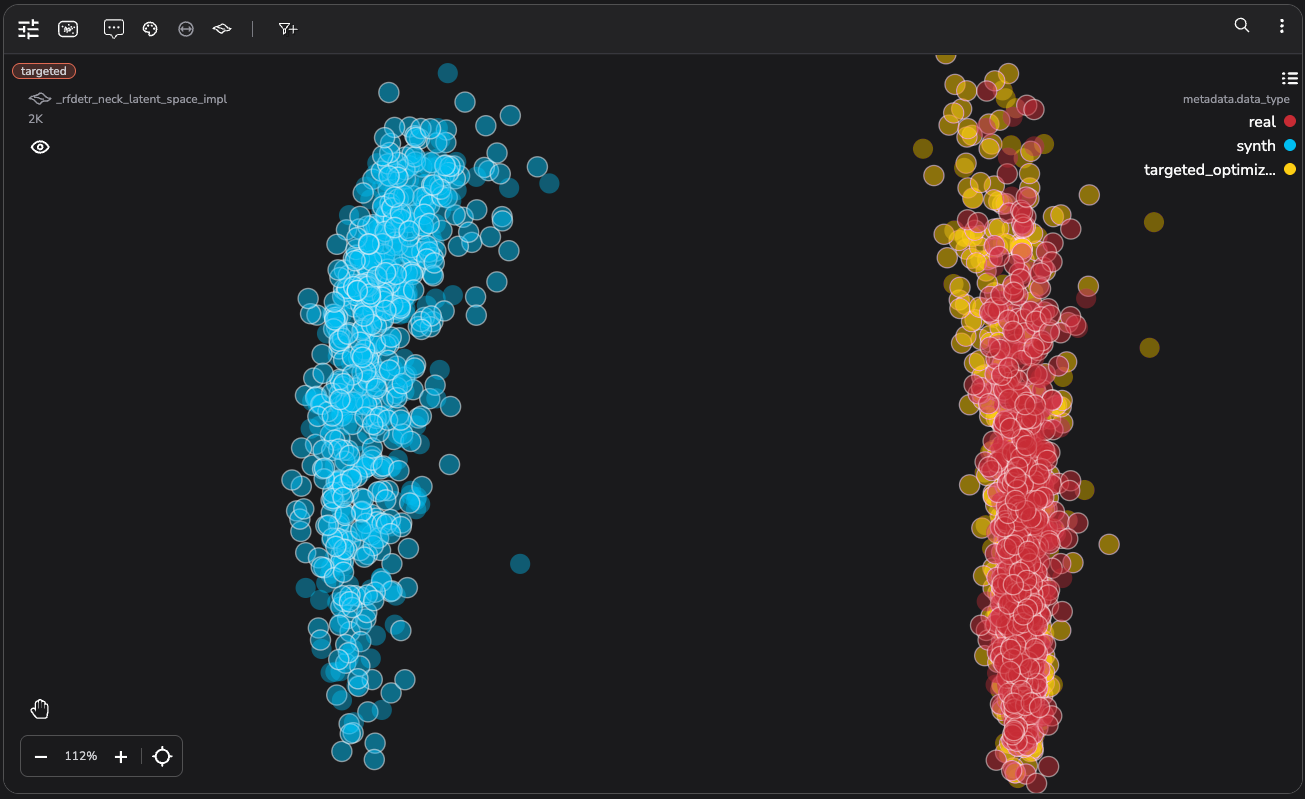
Tensorleap extracts the most informative activations and processes them into a compact latent representation for each sample. Together, these representations form the model's latent space: a map of the dataset from the model's own perspective. Samples located close together produced similar patterns of computation, even when the reason for that similarity is not immediately obvious to a human observer.
This gives simulation a measurable target. Real-world samples define the region the synthetic data needs to cover, and every simulated sample can be placed within the same space. We can then measure whether a change to the simulation parameters moves the generated distribution toward or away from the real one. Latent space becomes the feedback signal connecting real-world data gaps to the scenes the simulator should generate.
The same representation powers Tensorleap's failure-mode analysis. Failing samples with similar activation patterns cluster together, revealing coherent model behaviors associated with conditions such as camera geometry, object scale, or clutter.
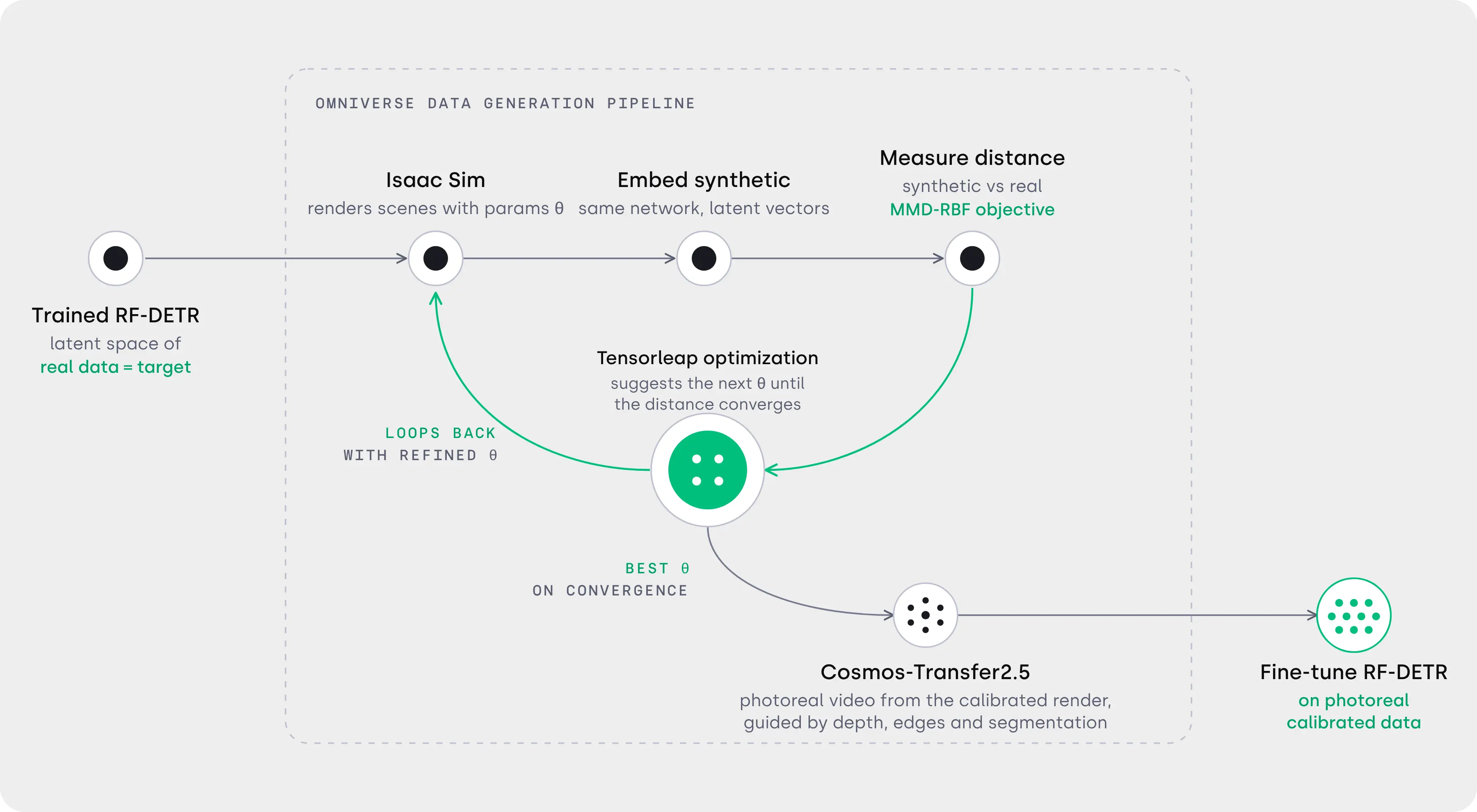
Tensorleap integrates with NVIDIA Omniverse™ libraries in the data-generation stack as a general optimization framework. This allows Tensorleap to connect the model's latent-space analysis to the parameters controlling synthetic-data generation, creating a feedback loop between model behavior and simulation. In this project, we applied that framework to warehouse object detection using synthetic data generation with Isaac Sim, RF-DETR, and Cosmos-Transfer2.5.
Real warehouse images first establish the target distribution in RF-DETR's latent space. Isaac Sim then renders synthetic scenes from a configurable set of simulation parameters, θ, controlling camera geometry, object placement, lighting, materials, motion, and other scene properties. The synthetic samples are passed through the same detector, and their distance from the real-data distribution becomes the optimization signal.
Tensorleap uses that signal to propose the next parameter configuration. Isaac Sim renders another batch, the model measures it again, and the process repeats until the distance converges. The best configuration then generates video clips together with depth, edge, and segmentation controls, which Cosmos-Transfer2.5 transforms into photorealistic video.
The two NVIDIA components address different parts of the domain gap. Synthetic data generation with Isaac Sim controls what the camera sees and how the scene is constructed; Cosmos improves how the calibrated scene looks while preserving its structure. The resulting photorealistic, model-targeted data is then used to fine-tune RF-DETR.
For each experiment, we trained RF-DETR on the same real-data training set combined with a different synthetic-data mix, then evaluated it on held-out real LOCO images from subset-3. The F1 chart shows final detection performance improved by 30%, while the per-epoch mAP curves show how performance developed throughout training.
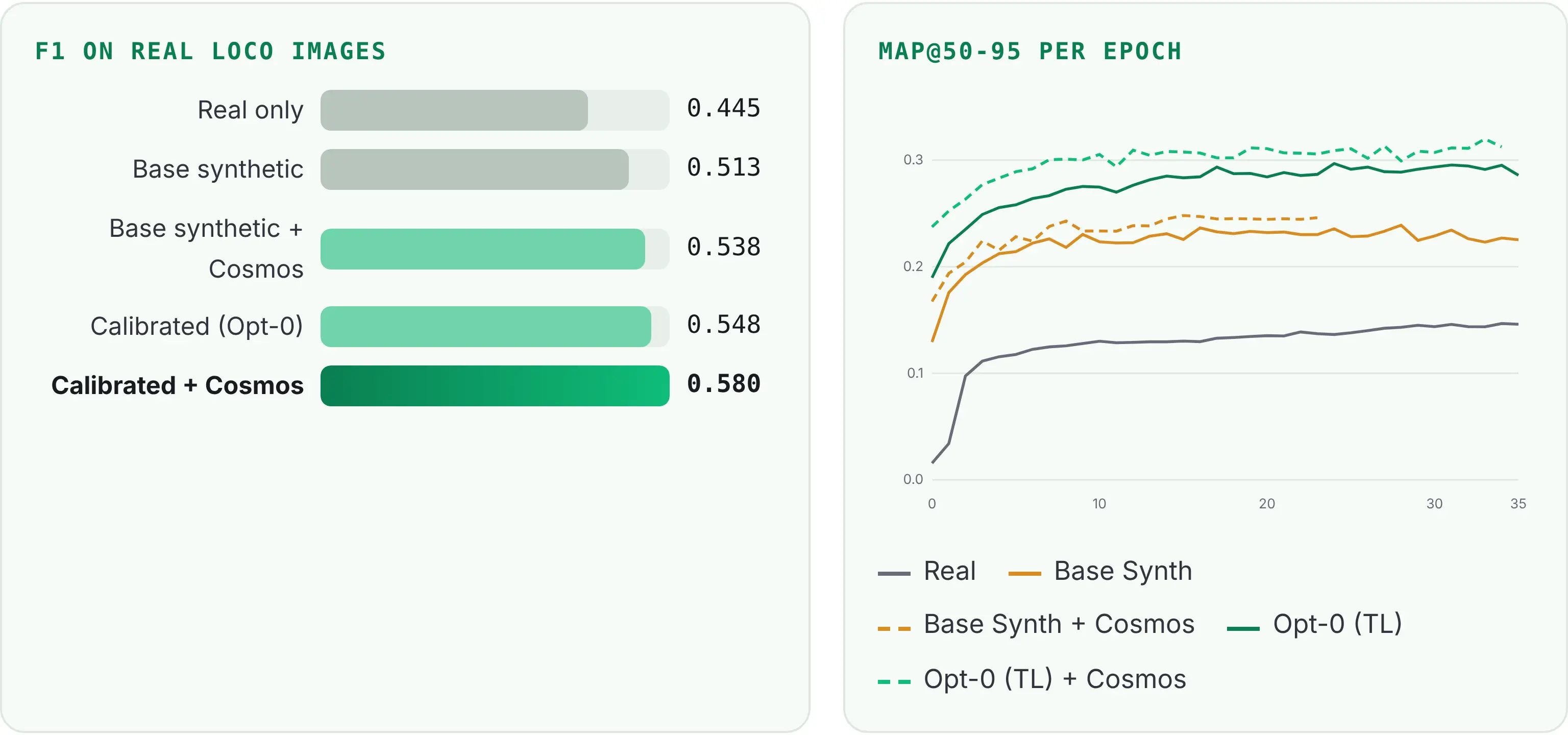
The results tell a clear story:
The next three plots look inside the calibration process. At the full-scene level, calibration steadily reduced the distance between synthetic and real data, and adding Cosmos on top brought the total reduction to 36%. At the object level, the distance between real and synthetic pallet_truck crops in RF-DETR's latent space fell from 0.76 to 0.4, and further to 0.29 with Cosmos. Finally, the parameter-importance analysis reveals what drove the search: the warehouse environment had the greatest influence, followed by materials and camera geometry.
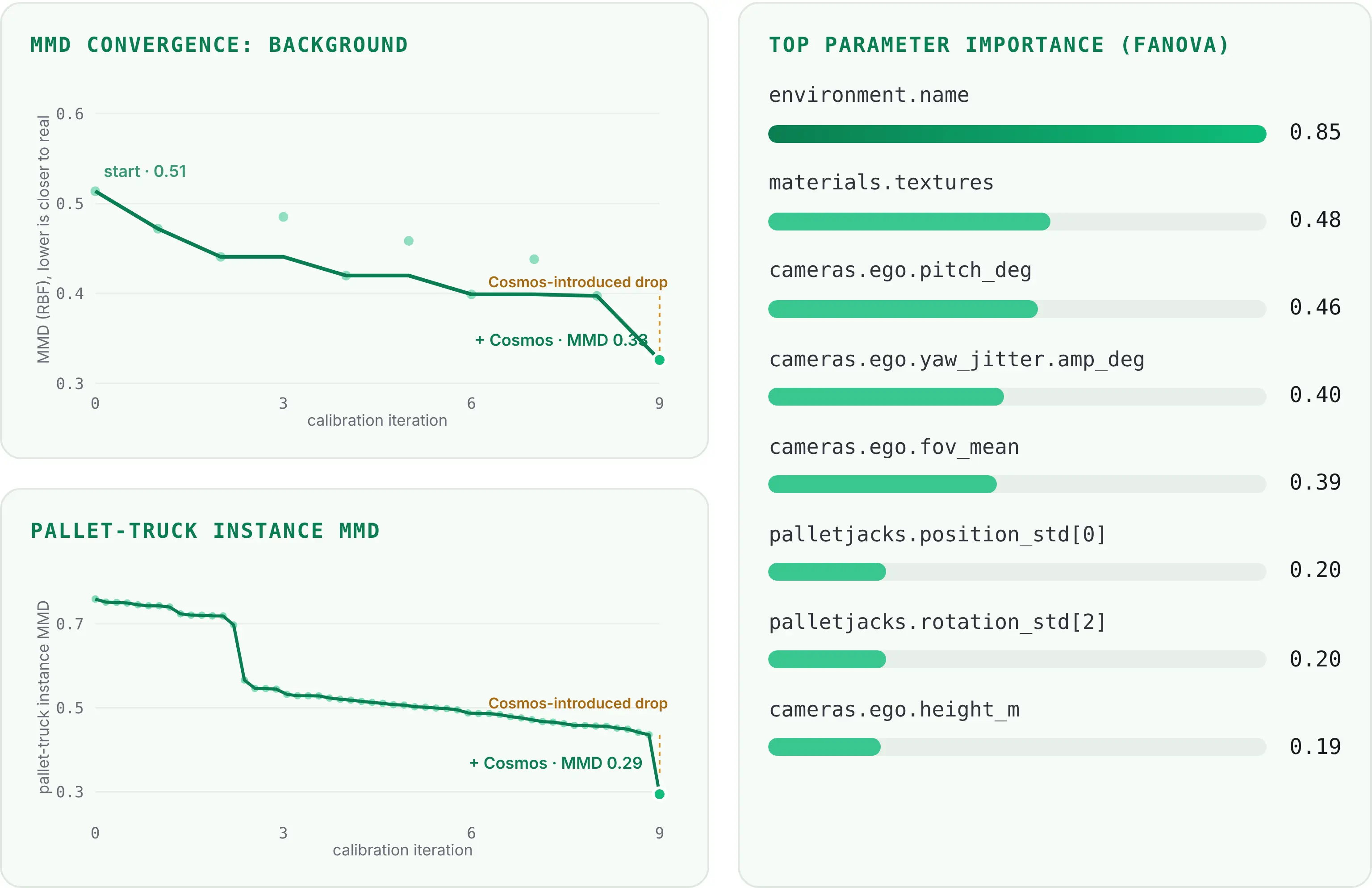
The charts show that calibration improved alignment and downstream performance. The gallery below shows what that means in practice: the optimization changed not only how the scenes looked, but what the camera saw, from aisle-focused framing and realistic camera geometry to plausible object placement, such as pallet trucks tucked beneath shelves.
Each pair contrasts an un-calibrated (off-target) configuration with a calibrated (on-target) one. Pick a pair to compare.
Extremely clutteredScene packed wall-to-wall, no navigable aisle, boxes fill the frame.
Human-height, clear aislesEye-level camera down open aisles, the everyday warehouse walk-through.
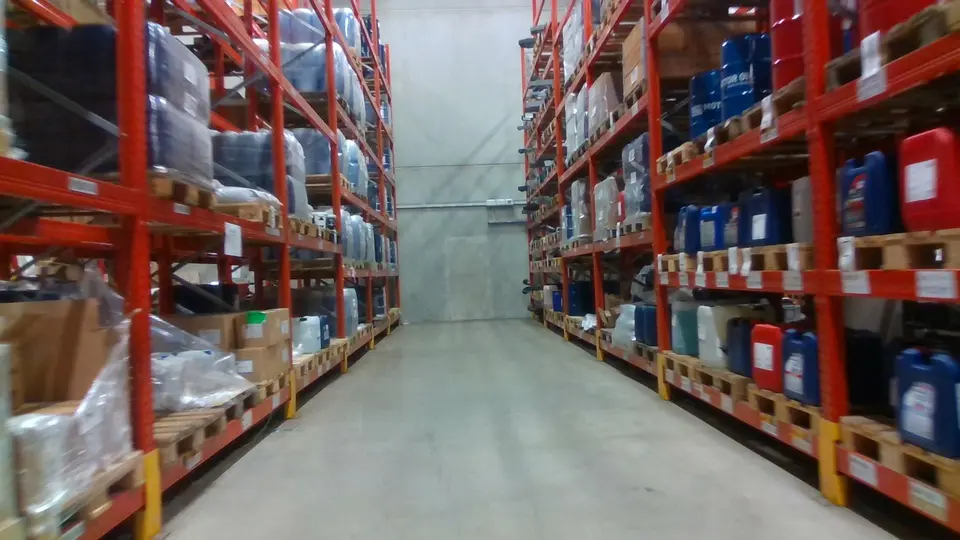
Low camera, narrow FOVRobot-height mount with a field of view far tighter than the target rig.
Low camera, wide-angle shotGround-truthed camera height and wide FOV that match the real patrol viewpoint.
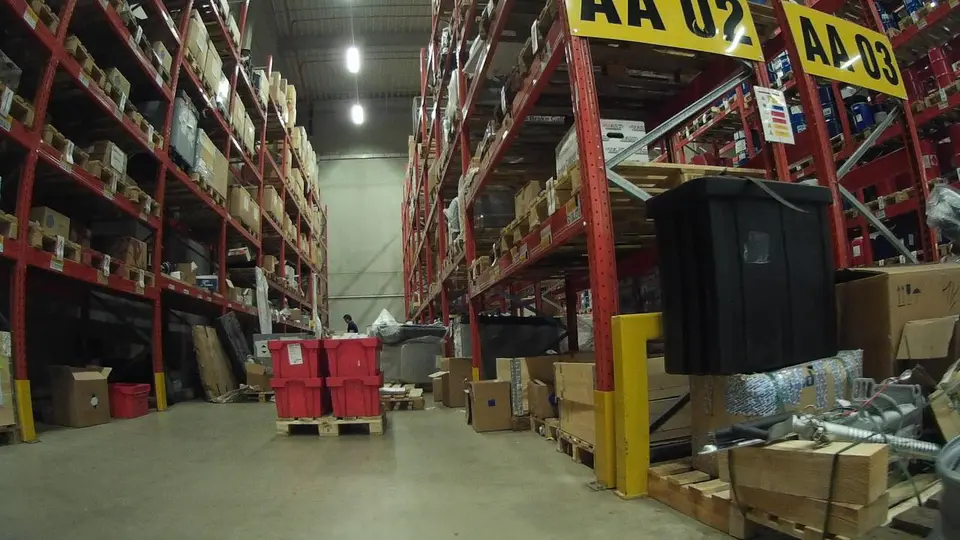
Unrealistic object positioningForklifts and pallets dropped into implausible spots for a working yard.
High movement, simulated motion blurFast camera motion with realistic blur: the hard, in-motion frames real cameras capture.
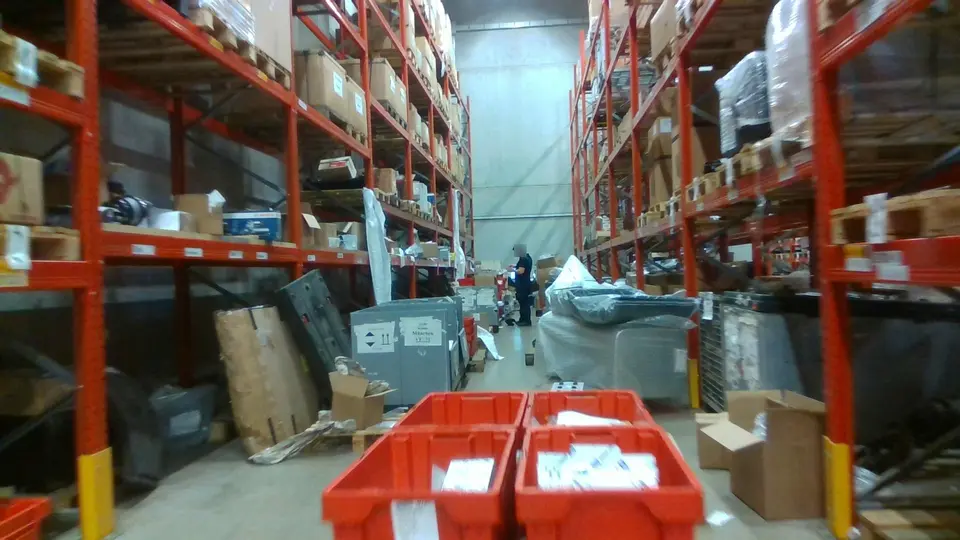
Security-camera viewSteep overhead survey angle, nothing like the deployed camera geometry.
High view, objects stay legibleElevated angle over a busy scene, yet each object remains clearly separable.
Figure 5. Off-target renders come from the same un-calibrated Isaac Sim configurations as "base synthetic" in the results chart; on-target renders use the loop's calibrated θ. Simulation renders play at 2× slow-down.
None of these changes were manually specified. They emerged from minimizing the latent-space distance to real data. Cosmos can make either configuration photorealistic, but only calibration ensures it renders the right scene.
Hand-tuning simulation parameters is expensive in ways that never show up on a GPU bill. An engineer picks parameters, renders a batch, reviews it by eye, and repeats: a high-latency loop that typically runs two to four weeks per tuning round and consumes tens of engineer-hours, because the only reliable way to test a guess is another fine-tune. Every off-target batch keeps costing money downstream, too: photoreal augmentation and training runs are spent on data the model never needed.
Once a simulation is connected to Tensorleap, all of this runs unsupervised: the loop proposes, renders, measures, and moves on by itself, recovering from failed renders without intervention. Engineer time shrinks from weeks of hands-on tuning to a single validation run at the end, and the expensive stages, Cosmos and fine-tuning, only ever run on scenes already proven to close the gap.
Faster time to market: shorter calibration rounds compound. Every cycle of generating, retraining and validating gets shorter, so a perception model reaches production-ready performance sooner. When deployment conditions change, whether a new site, a new camera rig or a new product line, the team can target the new gap in days instead of starting another month of manual tuning.
A better way for engineers to work: the engineer's role changes from running the loop to directing it. Instead of reviewing renders by eye and guessing which parameter to change next, they get a measurable answer: how far the synthetic data is from the real data, and which parameters are moving it. The parameter-importance analysis also shows what actually drives the gap, so each project leaves the team knowing more about its own data. Engineering time goes to decisions, model design and edge cases rather than repetitive tuning.
Synthetic data is no longer the constraint. NVIDIA Isaac Sim and Cosmos can generate varied, photorealistic scenes at scale; the harder question is which scenes will actually improve the model.
Tensorleap lets the model answer that question. It identifies the simulated conditions most likely to close the gap to real-world data before teams commit to large-scale rendering, augmentation, and retraining. The result is less trial-and-error, faster validation, and a more reliable path to production. In this project, that approach delivered a 30% improvement in detection F1 over real-data-only training.
NVIDIA built the stack that makes synthetic data abundant. Tensorleap, an NVIDIA Inception member, makes sure it is aimed at the right target.