The Deep Learning Debugging & Explainability Platform
Tensorleap helps AI teams understand, validate, and improve their models by analyzing how neural networks interpret data and why they fail, from the lab to live production.
From visibility to action
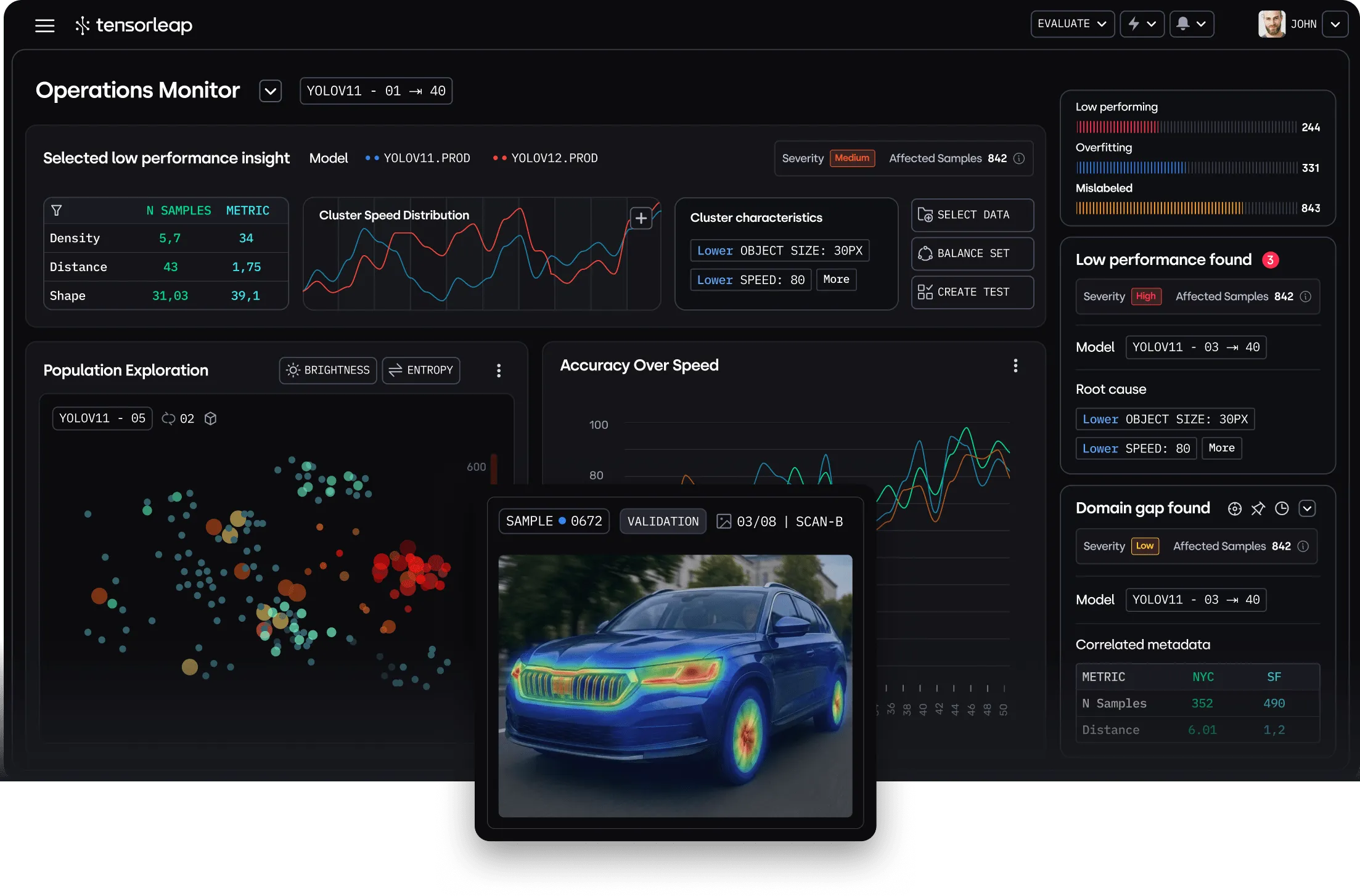
Tensorleap's shared analytical layer links activations, data, and semantics, enabling concept-level inspection for any model- from the lab through live production.
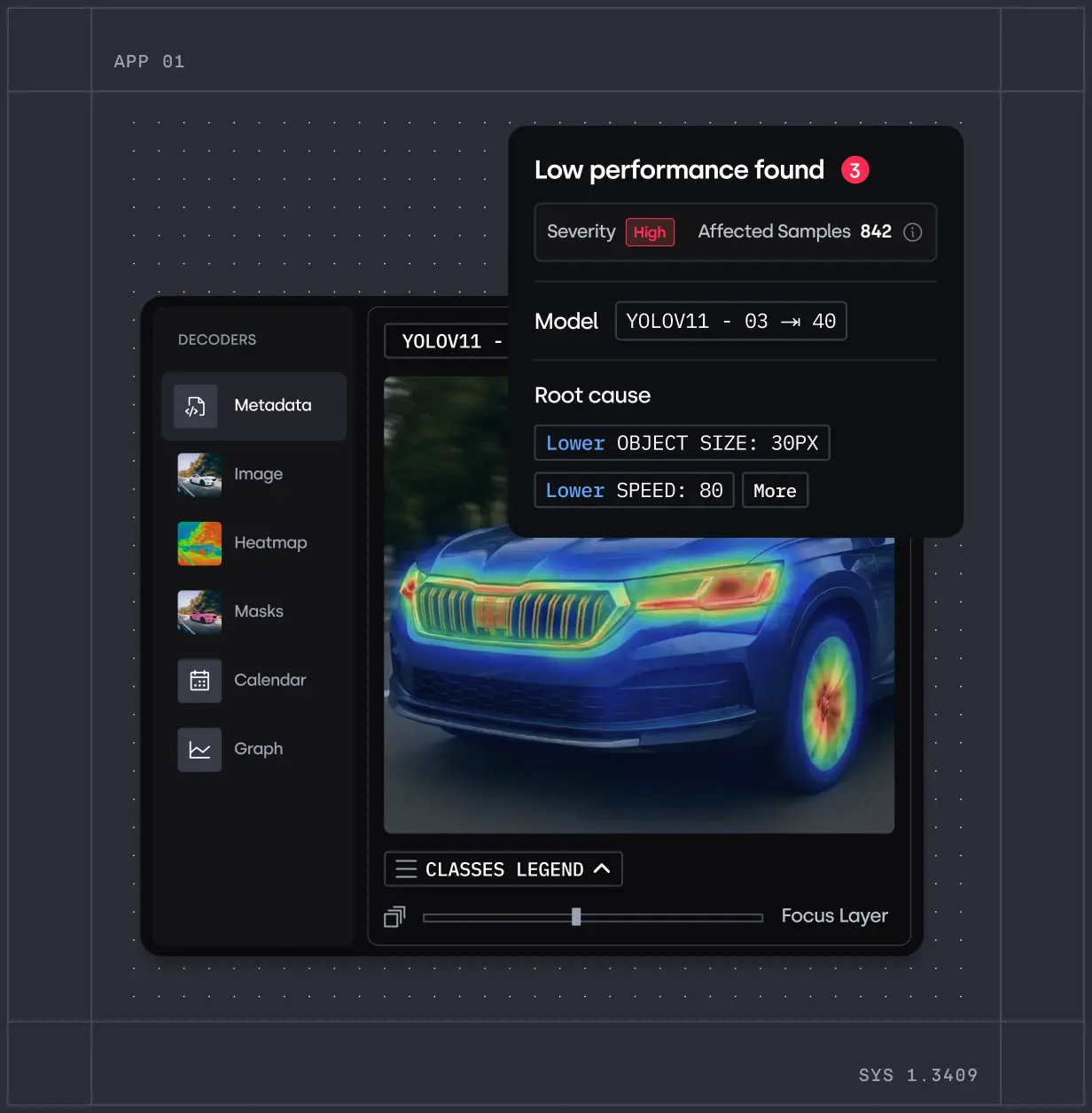
Tensorleap automatically surfaces and ranks semantic subgroups where your model underperforms, giving you the tools to fix them through targeted insights and guided improvements.
Automatic detection and ranking aggressors by severity
Characterizing failure patterns to accelerate root-cause analysis
Representative samples & heatmaps for visual explanations
Retrieval of similar unlabeled samples for targeted labeling
Reusable tests to track regressions across model versions
.webp)
Tensorleap identifies the concepts and features that cause models to behave differently across domains, including gaps between synthetic and real-world data. By comparing activations and metadata, it reveals how context, sensor, or environment shifts alter model focus, helping teams close the gaps that limit generalization.
Detect domain-specific concepts that impact model performance
Compare activations and metadata across datasets and environments
Guide targeted synthetic data generation to balance domain gaps
Tensorleap continuously watches deployed models and the live data flowing through them, detecting drift, domain gaps, and emerging failure modes as they form. Each alert carries the context that points to the root cause- so you act before a problem becomes a recall, line stoppage, or incident.
Real-time detection of drift, domain gaps, and emerging failure modes
Catch silent, high-confidence and out-of-distribution failures others miss
Get alerts with the context that points to root cause
Works on unlabeled production streams, at fleet scale
Failures flow straight into the debugging workflow for a verified fix

.webp)
Tensorleap helps data teams acquire, label, and structure the right data, using model-driven insights to eliminate guesswork, reduce waste, and strengthen training effectiveness.
Identify missing concepts your model struggles with to guide data acquisition
Reveal underrepresented cases to focus labeling efforts
Detect mislabeling that degrades training quality
Generate balanced dataset splits and weighted training sets to reduce leakage and improve generalization
From model to insight,
in three steps
Upload your trained model and lightweight integration code defining how data is preprocessed and passed through the model for analysis.
The platform analyzes internal activations and latent-space relationships, to uncover semantic patterns, failure clusters, and domain shifts.
Debug, optimize, and validate your model visually without changing your training workflow.